


White-Nose Syndrome
(CLICK HERE for the White-nose syndrome.org web site. It provides up-to-date FAQs, information, research, news and resources about WNS as well as the national plan for assisting states, federal agencies and tribes in managing WNS.)
The information below is from the FAQs. For a complete list of FAQs, CLICK HERE.)
From the FAQ:
What is WNS?
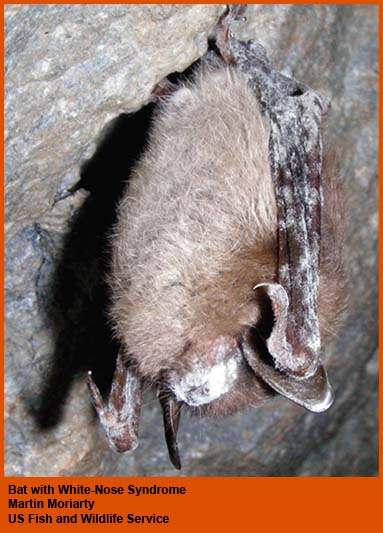
White-nose syndrome is a disease that is killing hibernating bats in eastern North America. WNS was first documented at four sites in eastern New York 2007. After that, photographs taken in February 2006 were found, showing affected bats at another site.
Named for the white fungus on the muzzles and wings of affected bats, WNS has rapidly spread to many sites throughout the eastern United States and into Canada. The fungus that causes WNS has been detected as far south as Mississippi. Researchers associate WNS with the newly identified fungus, Pseudogymnoascus destructans, which thrives in cold and humid conditions characteristic of caves and mines used by bats.
Bats affected with WNS do not always have obvious fungal growth, but they may behave strangely within and outside of their hibernacula (caves and mines where bats hibernate during the winter).
Where has WNS been observed?
White-nose syndrome has been confirmed in bat hibernation sites in 26 states and 5 Canadian provinces: Alabama, Arkansas, Connecticut, Delaware, Georgia, Illinois, Indiana, Iowa, Kentucky, Maine, Maryland, Massachusetts, Michigan, Missouri, New Hampshire, New Jersey, New York, North Carolina, Ohio, Pennsylvania, South Carolina, Tennessee, Vermont, Virginia, West Virginia, Wisconsin, New Brunswick, Nova Scotia, Ontario, Prince Edward Island and Quebec.
In addition, the fungus that causes white-nose syndrome, Pseudogymnoascus destructans, has been
found in four additional states: Minnesota, Mississippi, Nebraska and Oklahoma.
What is the effect of WNS on bats?
We have seen 90 to 100 percent mortality of bats (mostly little brown bats) at hibernacula in the northeastern United States. However, mortality may differ by site and by species within sites.
The endangered Indiana bat hibernates in many affected sites. We are closely monitoring Indiana bat populations in many hibernacula and, to the extent possible, in their summer maternity colonies. During the winter of 2008-2009, biologists conducted the biennial rangewide winter counts of Indiana bats. Population estimates based on this count show the overall Indiana bat population declined by approximately 17 percent. This is the first observed decline since 2001.
In addition to the Indiana bat, white-nose syndrome has reached the ranges of three more endangered bats: gray bats, Virginia big-eared bats and Ozark big-eared bats. The Northern long-eared bay was listed as threatened in 2015, the first bat species to be listed due to the effects of white-nose syndrome. We are closely monitoring these species as WNS continues to spread.
Partners and Sponsors